

BLOG
Logistics and storage challenges in the animal feed industry
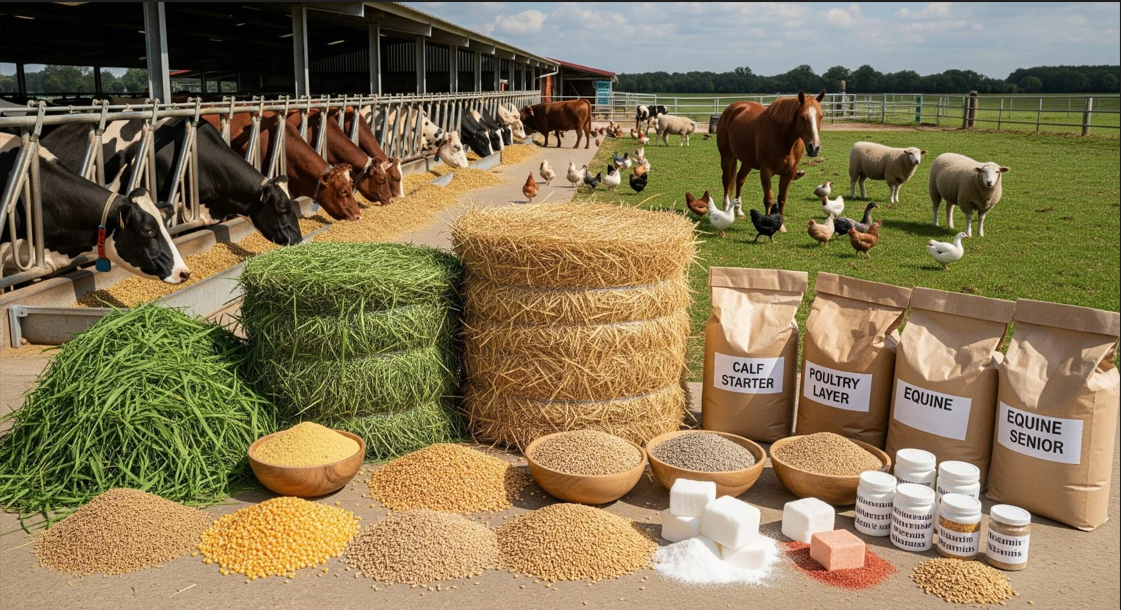
The animal feed industry is an important and stable market for agricultural commodities and agro-industrial by-products, such as oilcake and milling by-products, which are used to produce a wide range of feeds. Animal feed underpins efficient livestock production and plays a key role in the broader economy.
Logistics and storage are often regarded as the lifeline of any production-based industry, and in the animal feed sector, they play an indispensable role. Feed production is a complex and time-sensitive operation that relies heavily on the seamless movement of raw materials and ingredients. As a result, logistics extends across every stage of the value chain, from sourcing inputs to manufacturing and distributing finished products.
The feed industry is also one of the most consistent and significant sources of demand for grain handlers and silo operators, reinforcing the strong interdependence between the grain
and feed sectors. This interdependence places pressure on the efficiency and reliability of logistics systems. However, ensuring a stable flow of grain from farms and silos to feed mills is becoming more challenging due to infrastructure and logistical constraints, including declining rail capacity and growing reliance on road transport. In this context, efficient and resilient logistics systems are essential for sustaining continuity in feed supply.
The strategic role of logistics Supply chain management plays a strategic role in ensuring a reliable and continuous supply of feed to livestock producers. According to industry reports,
the global animal feed market is projected to reach US$415 billion by 2028, growing at a compound annual growth rate of approximately 4,2% (2021 to 2028).
While these figures highlight the scale of the industry, the efficiency of local supply chains remains a key determinant of competitiveness. As global demand expands, the ability of local industries to secure and efficiently manage raw materials becomes a critical driver of sustainable growth.
Raw material suppliers are drawn from a shared pool across the sector. For example, over 70% of grain and oilseed inputs are sourced from a relatively small number of suppliers, highlighting the importance of effective procurement strategies. At the same time, raw material prices are sensitive to global market forces, with grain prices often experiencing significant volatility within a single year, which necessitates robust demand planning.
These pricing pressures are further compounded by structural inefficiencies in the domestic logistics environment, which directly affect input costs and supply reliability. Over the past decade, declining rail capacity in South Africa has led to greater reliance on road transport for moving grain. While road transport offers flexibility, it typically results in higher
costs, increased congestion, and a greater risk of disruptions. Consequently, this shift has amplified logistical inefficiencies across the supply chain.
These inefficiencies contribute to higher feed costs, particularly in regions where feed mills are located some distance from grain-producing areas. Given that feed accounts for 60 to 70% of total livestock production costs, such logistical challenges have a serious impact on the competitiveness of the livestock sector. In this context, efficient grain storage infrastructure becomes a crucial complementary factor in mitigating logistical constraints and stabilising supply chains.
Storage and location
The ability to mitigate transportation disruptions depends heavily on the availability and strategic placement of grain storage facilities. According to the South African Grain Information Service (Sagis), South Africa has more than 20 million tonnes of registered
commercial grain storage capacity, largely concentrated in major grain-producing provinces such as the Free State, North West, and Mpumalanga. In addition,
on-farm storage capacity has expanded steadily, with estimates suggesting that seven to eight million tonnes of grain are stored on farms. This provides producers with greater flexibility in managing harvest timing, marketing decisions, and logistical flows.
While this extensive storage capacity serves as a critical buffer against supply chain disruptions, it does not fully compensate for systemic inefficiencies in transport and export infrastructure. Port congestion and rail capacity constraints, particularly along bulk commodity corridors operated by Transnet, remain persistent challenges. Declining rail performance over the past decade has shifted more than 80% of domestic grain transport to road, increasing costs and vulnerability to disruptions.
Investment in infrastructure improvements, such as strategically located silo facilities, is essential to mitigate these challenges. Well-positioned storage facilities enable efficient grain aggregation during harvest and facilitate year-round distribution, ensuring a stable supply for feed manufacturers. Conversely, poorly located or insufficient storage increases transport distances, raises costs, and reduces supply chain efficiency. Developing a well-distributed silo network is therefore vital for enhancing resilience and reducing costs in the livestock feed supply chain.
By Dr Lucius Phaleng, trade advisor, AFMA
0 COMMENTS
LEAVE A COMMENT